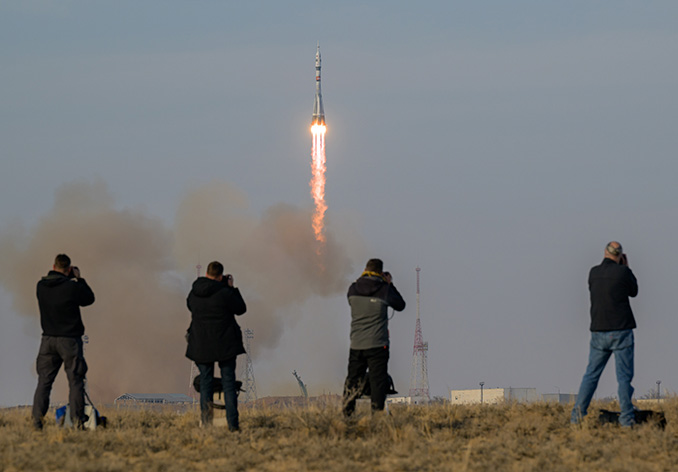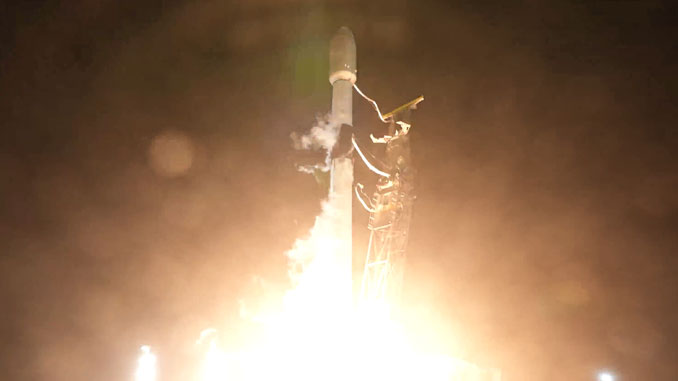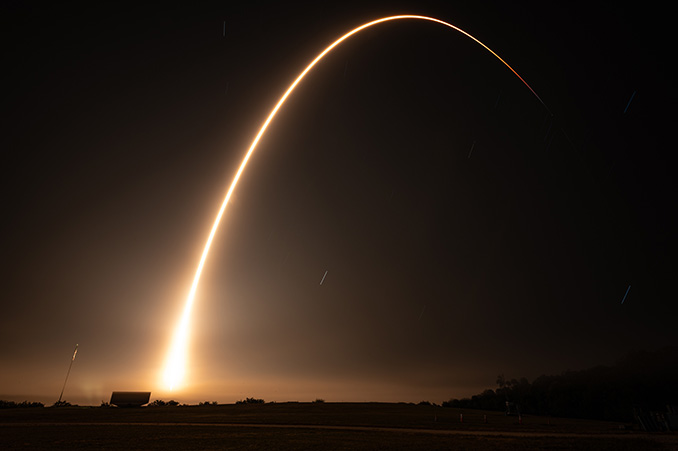

File: A SpaceX Falcon 9 rocket stands ready to launch the Starlink 7-14 mission from Vandenberg Space Force Base. Image: SpaceX
Update Oct. 19, 10:26 a.m. EDT (1426 UTC): SpaceX pushed back the T-0 liftoff time.
File: A SpaceX Falcon 9 rocket stands ready to launch the Starlink 7-14 mission from Vandenberg Space Force Base. Image: SpaceX
Update Oct. 19, 10:26 a.m. EDT (1426 UTC): SpaceX pushed back the T-0 liftoff time.
NASA’s Orion spacecraft, named ‘Integrity’ by her crew, rolled about seven miles from the Launch Abort System Facility to the Vehicle Assembly Building at NASA’s Kennedy Space Center on Oct. 16, 2025. The spacecraft will be the first crewed vehicle to travel to the Moon since Apollo 17, when it launches on the Artemis 2 mission no earlier than Feb. 5, 2026. Image: John Pisani / Spaceflight Now
NASA Orion spacecraft made its penultimate terrestrial roadtrip late Thursday evening when it cruised into the Vehicle Assembly Building at the Kennedy Space Center. The next time it hits the road will be atop the fully assembled Space Launch System rocket for final prelaunch preparations for Artemis 2 at the launch pad.
A SpaceX Falcon 9 rocket lifts off from Space Launch Complex 40 at Cape Canaveral Space Force Station to begin the Starlink 10-52 mission. Image: Adam Bernstein / Spaceflight Now
Update Oct. 16, 6:50 a.m. EDT (1050 UTC): SpaceX confirms deployment of the 28 Starlink satellites.
A SpaceX Falcon 9 rocket stands in the vertical launch position ahead of the liftoff of the Space Development Agency’s Tranche 1 Transport Layer C (T1TL-C) mission. Image: SpaceX
Update Oct. 14, 6:45 p.m. EDT (2245 UTC): SpaceX scrubbed Tuesday’s launch attempt.
A Rocket Lab Electron rocket lifts off from Launch Complex 1 at Mahia, New Zealand on the ‘Owl New World’ mission for Synspective. Image: Rocket Lab
Japan-based Earth observation company, Synspective, launched its seventh StriX satellite into low Earth orbit, part of a multi-launch deal with Rocket Lab.
SpaceX launches its 11th Starship-Super Heavy rocket from its headquarters at Starbase, Texas, on Monday, Oct. 13, 2025. Image: SpaceX
SpaceX closed a chapter in its Starship saga on Monday. It launched what appeared to be a nearly flawless suborbital mission with its Version 2 Starship-Super Heavy rocket, the final flight for this iteration of the launch vehicle.
A SpaceX Falcon 9 rocket stands in the vertical launch position at Space Launch Complex 40 (SLC-40) at Cape Canaveral Space Force Station on Oct. 12, 2025. The rocket will launch the Kuiper Falcon 03 (KF-03) mission for Amazon’s Project Kuiper broadband internet constellation. Image: SpaceX
After more than a week of launch delays, SpaceX is preparing to launch its Falcon 9 rocket from Cape Canaveral Space Force Station with two dozen of Amazon’s Project Kuiper broadband internet satellites onboard.
SpaceX’s Starship-Super Heavy rocket stands atop the orbital launch mount at Pad A at Starbase, Texas. Image: SpaceX
SpaceX is preparing for a notable flight for its Starship program. The company is scheduled to launch its Starship-Super Heavy rocket from its headquarters in Starbase, Texas, on Monday evening.
Blue Origin’s New Glenn, SpaceX’s Falcon 9 and ULA’s Vulcan rockets launch from their respective pads. Image: Blue Origin, SpaceX, United Launch Alliance
Getting newer and increasingly more capable assets in space for U.S. service members and allies is a primary goal for the U.S. Space Force. Among the challenges to bolstering America’s various on orbit capabilities though is having space on Earth to get them ready for launch.
SpaceX transports 24 Project Kuiper satellites inside its payload fairings from Amazon’s Payload Processing Facility at the Space Florida Launch and Landing Facility out to Space Launch Complex 40 (SLC-40) at Cape Canaveral Space Force Station. Image: Amazon
Update Oct. 9, 1:20 p.m. EDT (1720 UTC): SpaceX delayed the mission until Saturday, Oct. 11.
Blue Origin transported its New Glenn first stage booster, ‘Never Tell Me the Odds,’ from its facilities at Rocket Park to Launch Complex 36 at Cape Canaveral Space Force Station on Oct. 8, 2025. Image: John Pisani / Spaceflight Now
Blue Origin is one step closer to its second ever launch of its New Glenn rocket. On Wednesday morning, teams rolled the 189-foot-tall (57.5 m) booster from its faculties at Rocket Park near the Kennedy Space Center Visitor Complex to begin its journey out to Launch Complex 36 at Cape Canaveral Space Force Station.
File: A SpaceX Falcon 9 rocket stands in launch position at Space Launch Complex 4 East (SLC-4E) at Vandenberg Space Force Base at sunset. Image: SpaceX
Update Oct. 8, 12:25 a.m. EDT (0425 UTC): SpaceX landed the Falcon 9 booster on its drone ship.
A SpaceX Falcon 9 rocket lifts off from Space Launch Complex 40 (SLC-40) at Cape Canaveral Space Force Station to begin the Starlink 10-59 mission. Image: Adam Bernstein / Spaceflight Now
Update Oct. 7, 3:08 a.m. EDT (0708 UTC): SpaceX landed its first stage booster.
A Falcon Heavy roars passed the Moon as it launches the X-37B for the U.S. military. Image: Michael Cain/Spaceflight Now.
The latest missions carrying payloads for the U.S. Space Force (USSF) and the National Reconnaissance Office (NRO) were announced on Friday with a combined value of $1.142 billion. SpaceX was tasked with five missions and United Launch Alliance (ULA) received two.
File photo of a SpaceX Falcon 9 rocket at pad 4E ready to launch a Starlink mission. Image: SpaceX
SpaceX is preparing to launch its 125th Falcon 9 rocket of 2025, which will carry a batch of Starlink V2 Mini satellites into low Earth orbit. The company’s first mission of the month will take flight from Vandenberg Space Force Base Friday morning.
The ViaSat-3 F2 satellite in the El Segundo, California, Boeing satellite factory ahead of containerization and shipment. Image: Erik Isakson / Boeing)
The ViaSat-3 Flight 2 spacecraft, the next geostationary satellite for communications company Viasat, arrived in Florida in the early morning hours of Tuesday.
The Mary W. Jackson NASA Headquarters in Washington D.C. Image: NASA
A new report from the Democratic staff of the U.S. Senate Committee on Commerce, Science, and Transportation argues that NASA has been “illegally” implementing President Donald Trump’s proposed budget request (PBR) and ignoring the funding levels previously approved by Congress.
(Left to right) Axiom Space Chief Astronaut Michael López-Alegría trains with the first Axiom Space project astronaut Emiliano Ventura. Image: Axiom Space
Axiom Space is gearing up to launch the first module of its commercial space station as soon as next year, but it is also refining how it will train future crews to head into low Earth orbit.
An explosion captured by security camera footage shows the results of an anomaly seen during acceptance testing of Firefly Aerospace’s Alpha rocket booster designated for the Flight 7 mission. Image: Harold’s Auto Parts
Firefly Aerospace suffered a setback on its road to resuming launches with its Alpha rocket.
File: A SpaceX Falcon 9 rocket stands ready to launch the Starlink 7-14 mission from Vandenberg Space Force Base. Image: SpaceX
Update Sept. 28, 2:42 p.m. EDT (1842 UTC): SpaceX adjusted the T-0 liftoff time.
Sierra Space’s Dream Chaser spaceplane (right) and its Shooting Star cargo module (left) seen inside a processing facility at NASA’s Kennedy Space Center in Florida. Image: Sierra Space
The debut of Sierra Space’s cargo space plane Dream Chaser has delayed again and will no longer see a docking with the International Space Station. In a statement Thursday afternoon, NASA said the space agency and Sierra Space had agreed to a major modification of their space station resupply contract.
All Rights Reserved. 2026. SpaceZE.com