
Astrobotic staff examine a propulsion tank sitting in front of Griffin-1’s structure. Image: Astrobotic
Astrobotic is now eyeing the summer of 2026 for the launch of its second mission with the goal of landing on the surface of the Moon.
Astrobotic staff examine a propulsion tank sitting in front of Griffin-1’s structure. Image: Astrobotic
Astrobotic is now eyeing the summer of 2026 for the launch of its second mission with the goal of landing on the surface of the Moon.
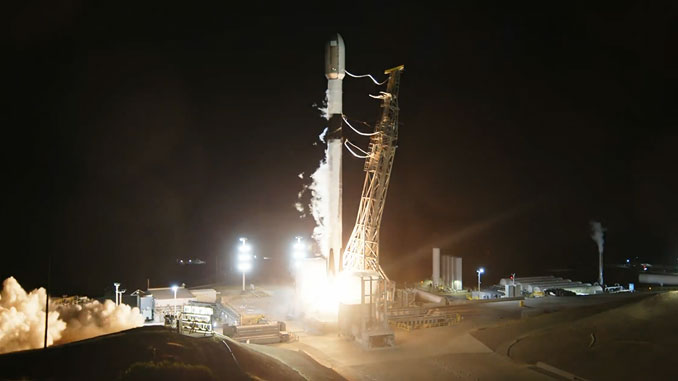
File: A SpaceX Falcon 9 rocket stands ready to launch the Starlink 7-14 mission from Vandenberg Space Force Base. Image: SpaceX
SpaceX will continue its rapid pace of launches Monday with the flight of a Falcon 9 rocket from Vandenberg Space Force Base in California.
SpaceX launches its Falcon 9 rocket from Space Launch Complex 40 (SLC-40) at Cape Canaveral Space Force Station on the Starlink 10-21 mission on Oct. 26, 2025. Image: John Pisani / Spaceflight Now
Update Oct. 26, 1 p.m. EDT (1700 UTC): SpaceX confirmed deployment of its 28 Starlink satellites.
A SpaceX Falcon 9 rocket flies away from Space Launch Complex 4 East (SLC-4E) at Vandenberg Space Force Base on the Starlink 11-12 mission on Oct. 25, 2025. Image: SpaceX
Update Oct. 25, 11:35 a.m. EDT (1535 UTC): SpaceX confirms deployment of the 28 Starlink satellites.
Technicians with the European Space Agency and Airbus/Airbus Netherlands are shown performing an illumination test on one of the solar array wing panels during installation on the Orion spacecraft for Artemis I inside the Neil Armstrong Operations and Checkout Building high bay at NASA’s Kennedy Space Center in Florida on Sept. 30, 2020. The solar arrays were extended, inspected, and then retracted, before installation on the spacecraft. Each solar array panel will generate 11 kilowatts of power and span about 63 feet. Image: NASA/Frank Michaux
Legacy names in European spaceflight and defense, Airbus, Leonardo and Thales, announced a memorandum of understanding on Thursday to combine forces in a new entity designed to rival other aerospace juggernauts in this arena, like Boeing, Lockheed Martin and SpaceX.
SpaceX’s Falcon 9 rocket streaks across the sky on the SpainSat NG-2 mission for Hisdesat as seen from St. Cloud, Florida. Image: Michael Cain / Spaceflight Now
Update Oct. 23, 10:25 p.m. EDT (0225 UTC): SpaceX deployed the SpainSat NG-2 satellite.
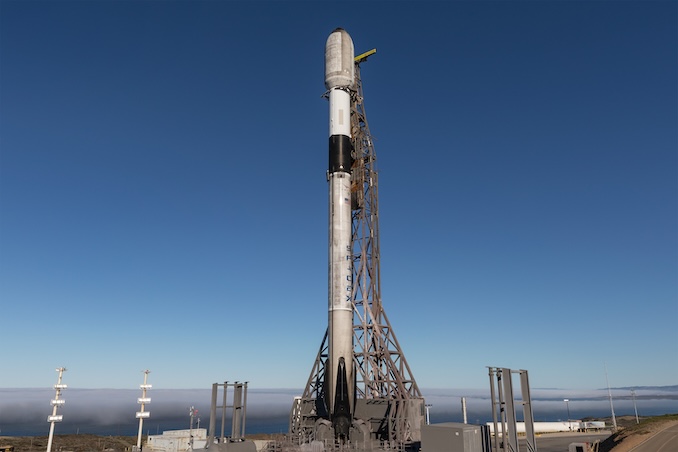
File – SpaceX’s Falcon 9 rocket stands in the vertical launch position at Space Launch Complex 4 East at Vandenberg Space Force Base ahead of the launch of the Starlink 17-5 mission on Aug. 18, 2025. This was the ninth flight for Falcon 9 booster, tail number B1088. Image: SpaceX
SpaceX is preparing to launch its 550th Falcon 9 mission since the rocket’s debut in 2010. The launch from California will add 28 more broadband internet satellites to the company’s Starlink constellation.
A SpaceX Falcon 9 rocket lifts off from Space Launch Complex 40 at Cape Canaveral Space Force Station to begin the Starlink 10-17 mission. This was the record-breaking 31st flight of Falcon 9 booster, 1067. Image: Adam Bernstein / Spaceflight Now
SpaceX broke another reuse record on Sunday when it launched a Falcon 9 booster for a 31st time.
File: A SpaceX Falcon 9 rocket stands ready to launch the Starlink 7-14 mission from Vandenberg Space Force Base. Image: SpaceX
Update Oct. 19, 10:26 a.m. EDT (1426 UTC): SpaceX pushed back the T-0 liftoff time.
NASA’s Orion spacecraft, named ‘Integrity’ by her crew, rolled about seven miles from the Launch Abort System Facility to the Vehicle Assembly Building at NASA’s Kennedy Space Center on Oct. 16, 2025. The spacecraft will be the first crewed vehicle to travel to the Moon since Apollo 17, when it launches on the Artemis 2 mission no earlier than Feb. 5, 2026. Image: John Pisani / Spaceflight Now
NASA Orion spacecraft made its penultimate terrestrial roadtrip late Thursday evening when it cruised into the Vehicle Assembly Building at the Kennedy Space Center. The next time it hits the road will be atop the fully assembled Space Launch System rocket for final prelaunch preparations for Artemis 2 at the launch pad.
A SpaceX Falcon 9 rocket lifts off from Space Launch Complex 40 at Cape Canaveral Space Force Station to begin the Starlink 10-52 mission. Image: Adam Bernstein / Spaceflight Now
Update Oct. 16, 6:50 a.m. EDT (1050 UTC): SpaceX confirms deployment of the 28 Starlink satellites.
A SpaceX Falcon 9 rocket stands in the vertical launch position ahead of the liftoff of the Space Development Agency’s Tranche 1 Transport Layer C (T1TL-C) mission. Image: SpaceX
Update Oct. 14, 6:45 p.m. EDT (2245 UTC): SpaceX scrubbed Tuesday’s launch attempt.
A Rocket Lab Electron rocket lifts off from Launch Complex 1 at Mahia, New Zealand on the ‘Owl New World’ mission for Synspective. Image: Rocket Lab
Japan-based Earth observation company, Synspective, launched its seventh StriX satellite into low Earth orbit, part of a multi-launch deal with Rocket Lab.
SpaceX launches its 11th Starship-Super Heavy rocket from its headquarters at Starbase, Texas, on Monday, Oct. 13, 2025. Image: SpaceX
SpaceX closed a chapter in its Starship saga on Monday. It launched what appeared to be a nearly flawless suborbital mission with its Version 2 Starship-Super Heavy rocket, the final flight for this iteration of the launch vehicle.
A SpaceX Falcon 9 rocket stands in the vertical launch position at Space Launch Complex 40 (SLC-40) at Cape Canaveral Space Force Station on Oct. 12, 2025. The rocket will launch the Kuiper Falcon 03 (KF-03) mission for Amazon’s Project Kuiper broadband internet constellation. Image: SpaceX
After more than a week of launch delays, SpaceX is preparing to launch its Falcon 9 rocket from Cape Canaveral Space Force Station with two dozen of Amazon’s Project Kuiper broadband internet satellites onboard.
SpaceX’s Starship-Super Heavy rocket stands atop the orbital launch mount at Pad A at Starbase, Texas. Image: SpaceX
SpaceX is preparing for a notable flight for its Starship program. The company is scheduled to launch its Starship-Super Heavy rocket from its headquarters in Starbase, Texas, on Monday evening.
Blue Origin’s New Glenn, SpaceX’s Falcon 9 and ULA’s Vulcan rockets launch from their respective pads. Image: Blue Origin, SpaceX, United Launch Alliance
Getting newer and increasingly more capable assets in space for U.S. service members and allies is a primary goal for the U.S. Space Force. Among the challenges to bolstering America’s various on orbit capabilities though is having space on Earth to get them ready for launch.
SpaceX transports 24 Project Kuiper satellites inside its payload fairings from Amazon’s Payload Processing Facility at the Space Florida Launch and Landing Facility out to Space Launch Complex 40 (SLC-40) at Cape Canaveral Space Force Station. Image: Amazon
Update Oct. 9, 1:20 p.m. EDT (1720 UTC): SpaceX delayed the mission until Saturday, Oct. 11.
Blue Origin transported its New Glenn first stage booster, ‘Never Tell Me the Odds,’ from its facilities at Rocket Park to Launch Complex 36 at Cape Canaveral Space Force Station on Oct. 8, 2025. Image: John Pisani / Spaceflight Now
Blue Origin is one step closer to its second ever launch of its New Glenn rocket. On Wednesday morning, teams rolled the 189-foot-tall (57.5 m) booster from its faculties at Rocket Park near the Kennedy Space Center Visitor Complex to begin its journey out to Launch Complex 36 at Cape Canaveral Space Force Station.
File: A SpaceX Falcon 9 rocket stands in launch position at Space Launch Complex 4 East (SLC-4E) at Vandenberg Space Force Base at sunset. Image: SpaceX
Update Oct. 8, 12:25 a.m. EDT (0425 UTC): SpaceX landed the Falcon 9 booster on its drone ship.
A SpaceX Falcon 9 rocket lifts off from Space Launch Complex 40 (SLC-40) at Cape Canaveral Space Force Station to begin the Starlink 10-59 mission. Image: Adam Bernstein / Spaceflight Now
Update Oct. 7, 3:08 a.m. EDT (0708 UTC): SpaceX landed its first stage booster.
All Rights Reserved. 2025. SpaceZE.com